How to Read Food Labels Like a Nutritionist
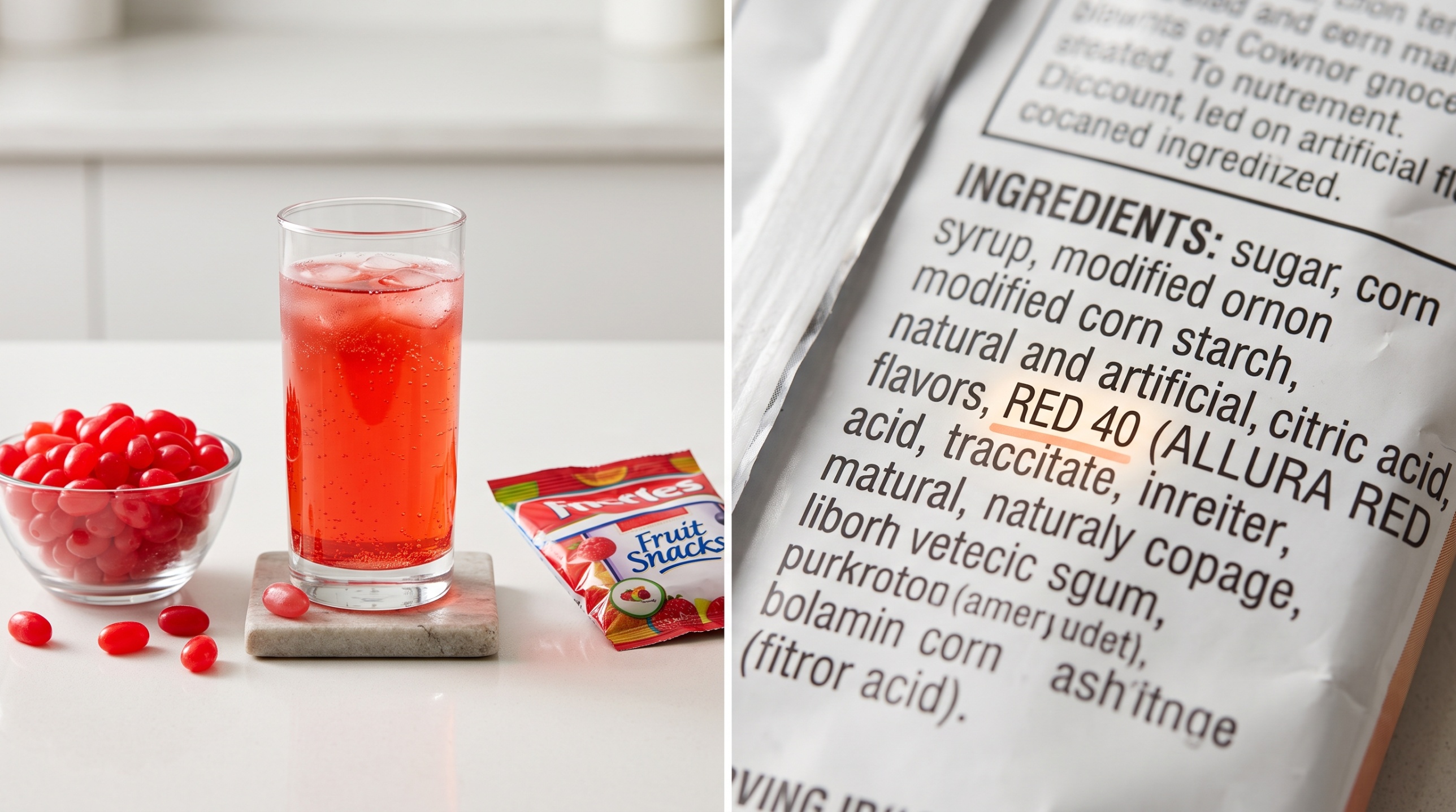
Have you ever picked up a food product that looked healthy… but wasn't? Imagine you're standing in the grocery store comparing two boxes of cereal. One proudly says "Natural," "Whole Grain," and "No Artificial Flavors." It sounds healthy, right? Now flip the package over and read the ingredient list.
You might discover added sugars, refined starches, preservatives, and artificial colors hidden behind unfamiliar names. This happens every day because food packaging is designed to catch your attention — but the ingredient list tells the real story.
Learning to read food labels is one of the most valuable skills you can develop for yourself and your family. Nutritionists don't rely on the marketing claims on the front of the package. Instead, they examine the Nutrition Facts panel and ingredient list to understand what's actually inside. In this guide, you'll learn the same step-by-step process nutrition professionals use to evaluate packaged foods.
Why Food Labels Matter
Packaged foods are everywhere — from breakfast cereals and snacks to frozen meals and beverages. While many can fit into a balanced diet, some contain ingredients that are easy to overlook. Reading labels can help you:
- Compare similar products
- Identify added sugars
- Monitor sodium intake
- Choose higher-fiber options
- Spot artificial colors and preservatives
- Recognize common allergens
- Understand serving sizes
- Align foods with your health goals
Even spending an extra 20–30 seconds reading a label can make a meaningful difference over time.
1Ignore the Front of the Package (At First)
The front of a package is designed for marketing. Phrases like "All Natural," "Made with Real Fruit," "Whole Grain," "Light," "Multigrain," and "Low Fat" can sound appealing, but they don't always tell the full nutritional story. A snack labeled "Made with Whole Grains" may still contain refined flour as its primary ingredient, along with added sugars.
Tip: Start by turning the package over and looking at the Nutrition Facts label and ingredient list before reading the marketing claims.
2Check the Serving Size
One of the most common mistakes consumers make is overlooking the serving size. A bag of chips might list 150 calories per serving of 15 chips — but if the whole bag contains 4 servings, eating it all means consuming 600 calories, plus four times the sodium and fat.
Tip: Always compare products using the same serving size whenever possible.
3Look at Calories in Context
Calories provide energy, but they don't tell you everything about a food's nutritional quality. 200 calories from almonds provide healthy fats, protein, and fiber, while 200 calories from candy provide mostly added sugars with fewer beneficial nutrients. Rather than focusing only on calories, consider the overall nutrient profile.
4Read the Ingredient List Carefully
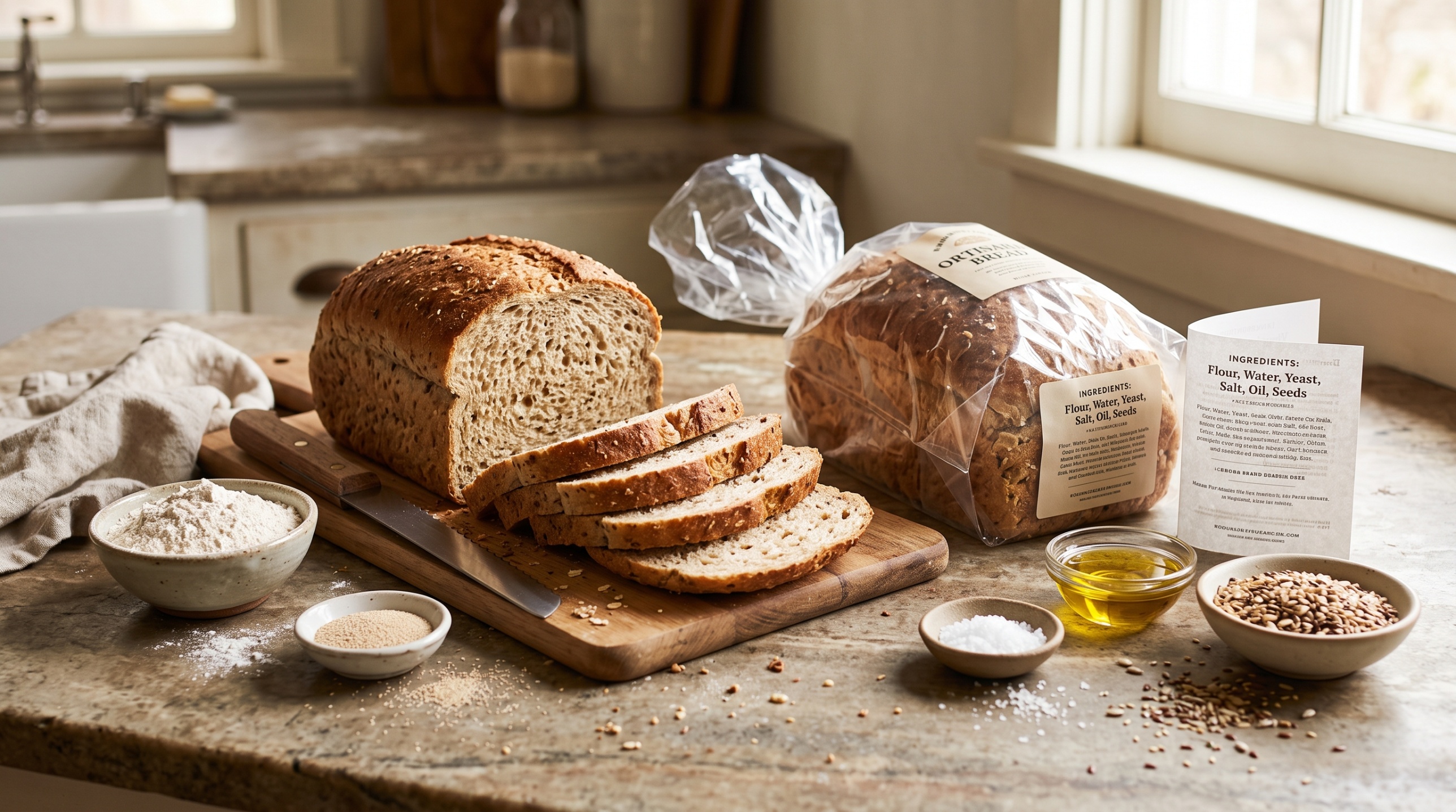
Ingredients are listed in descending order by weight, meaning the first ingredient is present in the greatest amount. Compare "Granola A" (Whole Grain Oats, Almonds, Honey…) with "Granola B" (Sugar, Corn Syrup, Refined Flour…). Even with similar calorie counts, the first provides more whole-food ingredients.
5Watch for Hidden Sugars
Added sugars appear under many different names, making them easy to miss. A product containing several different sweeteners may have more added sugar than you realize. Some common names include:
- Cane Sugar
- Corn Syrup
- High Fructose Corn Syrup
- Dextrose
- Maltose
- Glucose
- Fructose
- Brown Rice Syrup
- Honey
- Agave Syrup
- Molasses
- Fruit Juice Concentrate
6Understand the Nutrition Facts Panel
The Nutrition Facts label helps you evaluate key nutrients. Pay particular attention to:
Saturated Fat
Most dietary guidelines recommend limiting saturated fat as part of an overall healthy eating pattern.
Sodium
Many packaged foods contain significant amounts of sodium, even those that don't taste salty.
Added Sugars
The label now separates Added Sugars from naturally occurring sugars, making it easier to compare products.
Dietary Fiber
Fiber supports digestive health and can help you feel fuller for longer.
Protein
Protein contributes to muscle maintenance and can increase satiety.
Daily Value (%DV): What Does It Mean?
The % Daily Value helps you understand whether a nutrient is low or high in one serving. A general rule of thumb:
5% DV or less
Considered low
20% DV or more
Considered high
For nutrients to limit (like sodium or added sugars), lower values are generally preferable. For beneficial nutrients (like fiber), higher values may be desirable.
7Learn to Recognize Ultra-Processed Foods
Not every packaged food is unhealthy. Frozen vegetables, plain yogurt, canned beans, and frozen fruit are all processed to some extent, yet they can still be nutritious choices. The key is understanding the difference between processed and ultra-processed foods.
Minimally Processed Foods
Basic processing that keeps foods close to their natural state.
- Frozen fruits and vegetables
- Plain Greek yogurt
- Unsalted nuts
- Rolled oats
- Brown rice
- Frozen fish
- Plain popcorn kernels
Ultra-Processed Foods
Often contain industrial additives uncommon in home kitchens.
- Sugary breakfast cereals
- Candy
- Soft drinks
- Packaged pastries
- Flavored chips
- Instant noodles
- Some frozen dinners
Ultra-processed foods are often high in added sugars, refined starches, unhealthy fats, and sodium while being lower in fiber and other beneficial nutrients.
Signs a food may be ultra-processed — ask yourself:
- Does the ingredient list contain 20 or more ingredients?
- Are there many unfamiliar chemical names?
- Are there several different types of added sugar?
- Does it contain artificial colors?
- Does it contain artificial sweeteners?
- Does it contain multiple preservatives?
- Is refined flour listed before whole grains?
The more “Yes” answers you have, the more processed the food is likely to be.
8Don't Be Afraid of Long Ingredient Lists
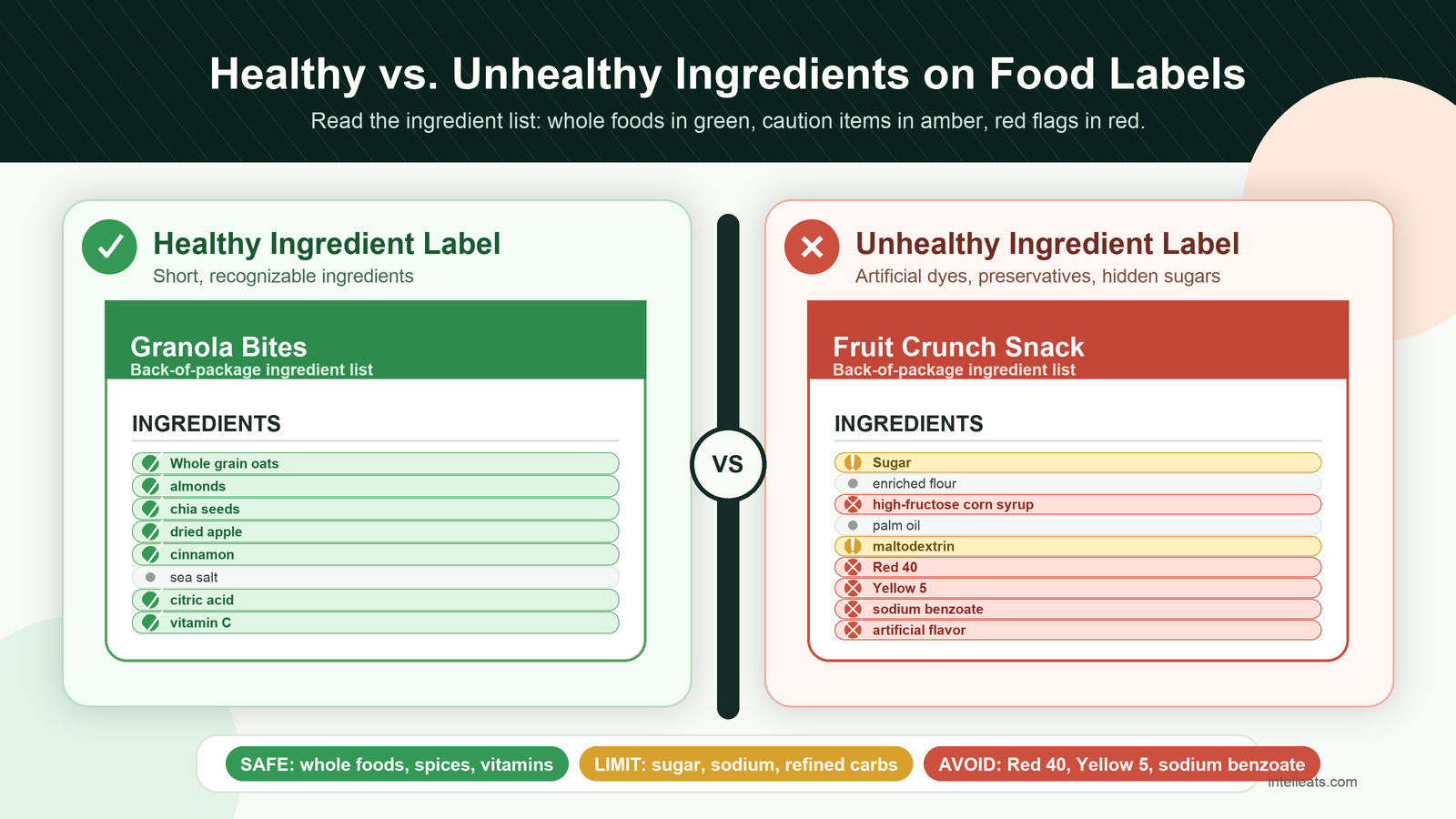
A long ingredient list doesn't automatically mean a product is unhealthy. What matters is the quality of the ingredients, not the count.
Product A
Rolled oats, almonds, walnuts, raisins, pumpkin seeds, chia seeds, flaxseed, cinnamon.
Long list — but every ingredient is a recognizable food.
Product B
Sugar, enriched flour, corn syrup, maltodextrin, artificial flavor, Red 40, Yellow 5, sodium benzoate, TBHQ.
Shorter list — but several highly processed ingredients.
Instead of counting ingredients, evaluate their quality.
9Learn Common Ingredient Categories
Nutritionists mentally group ingredients into categories rather than evaluating each one individually. Recognizing categories — added sugars, refined starches, preservatives, artificial colors, and flavor enhancers — lets you assess a product at a glance instead of researching every unfamiliar name.
| Ingredient Type | Examples |
|---|---|
| Whole Foods | Oats, Beans, Nuts, Fruits |
| Whole Grains | Brown Rice, Quinoa, Whole Wheat |
| Healthy Oils | Olive Oil, Avocado Oil |
| Refined Grains | White Flour, Modified Starch |
| Added Sugars | Cane Sugar, Corn Syrup |
| Artificial Colors | Red 40, Yellow 5, Blue 1 |
| Artificial Sweeteners | Aspartame, Sucralose |
| Preservatives | Sodium Benzoate, Potassium Sorbate |
| Emulsifiers | Soy Lecithin, Carrageenan |
| Flavor Enhancers | Monosodium Glutamate (MSG), Yeast Extract |
Grouping ingredients this way makes it easier to assess a product quickly.
10Understand “Natural Flavors”
“Natural flavors” can be one of the most misunderstood terms on food labels. According to U.S. regulations, natural flavors are derived from plant or animal sources. However, the label doesn't have to specify exactly what those sources are.
For someone with allergies or dietary restrictions, this lack of detail can make ingredient evaluation more challenging. Natural flavors are not necessarily unhealthy, but they also don't tell you much about what contributes to the food's taste.
11Learn the Different Names for Salt
Most people only look for the word “salt,” but sodium can appear in many forms. Common examples include:
- Sodium chloride
- Sodium bicarbonate
- Monosodium glutamate (MSG)
- Sodium benzoate
- Sodium phosphate
- Baking soda
Foods marketed as “healthy” can still contain high amounts of sodium, so always check the Nutrition Facts panel.
12Identify Different Types of Fats
Not all fats have the same nutritional profile.
Generally Encouraged
- Olive oil
- Avocado oil
- Nuts
- Seeds
- Fatty fish
Consume in Moderation
- Butter
- Coconut oil
- Palm oil
Avoid Artificial Trans Fats
Check ingredient lists for partially hydrogenated oils, which indicate artificial trans fats — even though they are largely removed from the U.S. food supply.
13Watch Out for Misleading Marketing Claims
Food packaging often uses terms that sound healthier than they actually are.
| Claim | What It May Mean |
|---|---|
| Natural | Doesn't necessarily mean minimally processed. |
| Multigrain | May contain mostly refined grains. |
| Light | Could refer to flavor, color, or reduced calories. |
| No Added Sugar | May still contain naturally occurring sugars or sweet fruit concentrates. |
| Gluten-Free | Doesn't automatically mean healthier. |
| Organic | Organic products can still contain added sugar or sodium. |
The best approach is to verify these claims by reading the ingredient list.
14Compare Similar Products
Imagine you're choosing between two granola bars.
Granola Bar A
- Whole oats
- Almonds
- Honey
- Pumpkin seeds
- 4g added sugar
- 5g fiber
Granola Bar B
- Corn syrup
- Sugar
- Refined flour
- Palm oil
- Artificial flavor
- 12g added sugar
- 1g fiber
Even if both bars contain similar calories, Granola Bar A provides more whole-food ingredients and fiber, making it a more nutrient-dense choice.
15Keep an Eye on Added Sugars
The updated Nutrition Facts label distinguishes Added Sugars from naturally occurring sugars. For example, a plain yogurt may contain lactose (a naturally occurring milk sugar), while a flavored yogurt may contain lactose plus added cane sugar or fruit syrup.
Choosing products with lower amounts of added sugar can help reduce overall sugar intake.
Nutritionist's Grocery Store Checklist
Before placing a product in your cart, ask yourself:
- Is a whole food listed as the first ingredient?
- Does it provide dietary fiber?
- Is the amount of added sugar reasonable?
- Is sodium within your dietary goals?
- Does it avoid unnecessary artificial colors?
- Are most ingredients recognizable?
- Is the serving size realistic for how much you'll eat?
If the answer to most of these questions is “Yes,” the product is often a good candidate for your shopping cart.
How IntelliEats Can Help
Reading ingredient labels becomes easier with practice, but comparing dozens of products while shopping can still be time-consuming.
The IntelliEats app helps simplify this process by scanning ingredient lists and highlighting ingredients that may be important based on your dietary preferences. Instead of searching for unfamiliar names one by one, you can quickly identify ingredients and learn more about their purpose in food.
Remember, no app replaces professional medical or dietary advice, but tools like IntelliEats can make ingredient labels easier to understand and support more informed shopping decisions.
Applying label-reading skills to real-life situations — kids, pregnancy, allergies, and side-by-side comparisons.
16Reading Food Labels for Children
Children are still developing healthy eating habits, so it's especially important to understand what's in the foods they eat. While no single ingredient determines whether a food is “good” or “bad,” reading labels can help you make more informed choices. When comparing snacks for kids, consider looking for:
- Whole grains as one of the first ingredients
- Fruits, vegetables, nuts, or seeds (when age-appropriate and allergy-safe)
- Good sources of dietary fiber
- Moderate amounts of added sugars
- Simple, recognizable ingredient lists
Instead of aiming for perfection, focus on choosing foods that provide a good balance of nutrients most of the time.
17Reading Labels During Pregnancy
Pregnancy increases the need for certain nutrients while also making food safety especially important. When selecting packaged foods during pregnancy, consider:
- Checking for allergens if advised by your healthcare provider
- Looking at sodium levels if you have been advised to monitor them
- Comparing added sugar between similar products
- Choosing foods that provide fiber, protein, vitamins, and minerals
- Following guidance from your healthcare provider regarding caffeine, supplements, and specific ingredients
If you have questions about ingredients during pregnancy, consult your physician or a registered dietitian rather than relying solely on internet sources.
18Reading Labels for Food Allergies
For people with food allergies, the ingredient list is only part of the picture. In the United States, food manufacturers are required to clearly identify the nine major food allergens:
- Milk
- Eggs
- Fish
- Crustacean shellfish
- Tree nuts
- Peanuts
- Wheat
- Soy
- Sesame
Many labels also include voluntary advisory statements such as:
- “May contain peanuts”
- “Processed in a facility that also processes tree nuts”
- “Manufactured on shared equipment”
19Comparing Similar Products Like a Nutritionist
Professional nutritionists rarely judge a product in isolation. Instead, they compare it with similar products. For example, imagine choosing between two tomato sauces.
| Nutrient | Sauce A | Sauce B |
|---|---|---|
| Sodium | 520 mg | 280 mg |
| Added Sugar | 8 g | 2 g |
| Fiber | 1 g | 3 g |
| First Ingredient | Tomato Puree | Tomatoes |
Although both sauces serve the same purpose, Sauce B provides less sodium, less added sugar, and more fiber, making it a stronger choice for many people. This side-by-side comparison technique can be applied to cereals, yogurts, breads, soups, granola bars, and many other packaged foods.
20Common Food Label Mistakes
Mistake #1: Only Looking at Calories
Calories are just one part of the story. Two foods with the same calorie count can have very different nutritional value.
Mistake #2: Ignoring Serving Size
Many packages contain multiple servings. Always check how many servings are in the container before comparing products.
Mistake #3: Trusting Front-of-Package Claims
Words like “natural,” “healthy,” or “multigrain” are not enough to judge a product. Always verify by reading the Nutrition Facts panel and ingredient list.
Mistake #4: Avoiding Every Ingredient with a Long Name
Some ingredients with scientific names are simply vitamins or minerals — such as Ascorbic Acid (Vitamin C), Tocopherols (Vitamin E), and Citric Acid (naturally found in citrus fruits). A long name does not automatically mean an ingredient is harmful.
Mistake #5: Assuming “Sugar-Free” Means Healthy
A product without sugar may still contain artificial sweeteners, refined starches, saturated fats, or high sodium. Look at the overall nutrition profile rather than a single claim.
A Simple 60-Second Label Reading Routine
- 1Check the serving size.
- 2Look at calories in context.
- 3Review added sugars, sodium, fiber, and protein.
- 4Read the first five ingredients.
- 5Compare with another brand before deciding.
With practice, this process takes less than one minute.
How Technology Can Make Label Reading Easier
Reading food labels becomes easier with experience, but shopping in a busy grocery store can still be overwhelming. Ingredient names can be long, unfamiliar, or difficult to compare across products.
Apps like IntelliEats can simplify the process by scanning ingredient lists and highlighting ingredients based on your dietary preferences. Instead of searching online for every unfamiliar ingredient, you can quickly access explanations and make more informed decisions.
Technology is most useful when paired with good nutrition knowledge — not as a replacement for it.
Frequently Asked Questions
Is a long ingredient list always unhealthy?
No. A product containing many whole-food ingredients, such as nuts, seeds, herbs, and spices, can still be an excellent choice.
What should I look at first on a food label?
Start with the serving size, then review the ingredient list and key nutrients such as fiber, protein, sodium, and added sugars.
Are all food additives harmful?
No. Many additives improve food safety, texture, or shelf life and have been evaluated for approved uses. Others may be ingredients some consumers prefer to limit. Understanding an additive’s purpose is more helpful than assuming all additives are harmful.
What is the best way to compare two products?
Compare serving size, ingredient order, added sugars, sodium, fiber, protein, and the type of fats.
Should I avoid every ingredient I can’t pronounce?
No. Scientific names don’t necessarily indicate an ingredient is unsafe. Learn what the ingredient does before deciding whether it aligns with your dietary goals.
Key Takeaways
- Don't judge a product by the front of the package.
- Read the Nutrition Facts panel and ingredient list together.
- Compare similar products before buying.
- Focus on overall dietary patterns rather than a single ingredient.
- Choose foods that fit your nutritional needs and personal preferences.
- Use trusted resources and consult healthcare professionals for medical or dietary advice when needed.
Final Thoughts
Learning to read food labels is one of the most practical skills you can develop for healthier grocery shopping. While it may seem overwhelming at first, it quickly becomes second nature with practice.
Rather than aiming for a “perfect” diet, focus on making informed choices more often. Small improvements — such as comparing products, recognizing added sugars, or choosing higher-fiber options — can add up over time.
Whether you're shopping for yourself, your children, or your family, understanding food labels helps you move beyond marketing claims and make decisions based on what's actually inside the package.
References
- U.S. Food and Drug Administration (FDA). "How to Understand and Use the Nutrition Facts Label." fda.gov/food/nutrition-facts-label
- U.S. Department of Agriculture (USDA). "Dietary Guidelines for Americans, 2025–2030." dietaryguidelines.gov
- National Institutes of Health (NIH). "Office of Dietary Supplements." ods.od.nih.gov
- World Health Organization (WHO). "Healthy Diet Fact Sheet." who.int/news-room/fact-sheets/detail/healthy-diet
- Academy of Nutrition and Dietetics. "Resources on Nutrition Labels and Healthy Eating." eatright.org
- Food Allergy Research & Education (FARE). "Food Allergen Labeling Information." foodallergy.org
Research & Regulatory Further Reading
The sources below provide background on food labeling, regulation, and research relevant to this topic. They do not establish that any individual ingredient is harmful at typical food exposure levels.
Medical Disclaimer
The information in this article is provided for educational purposes only and is not intended as medical, nutritional, or dietary advice. Ingredients approved by regulatory authorities are considered safe when used within established limits. Always consult a qualified healthcare professional or registered dietitian for guidance tailored to your personal health needs. See our Editorial Policy to learn how we research and review our content.