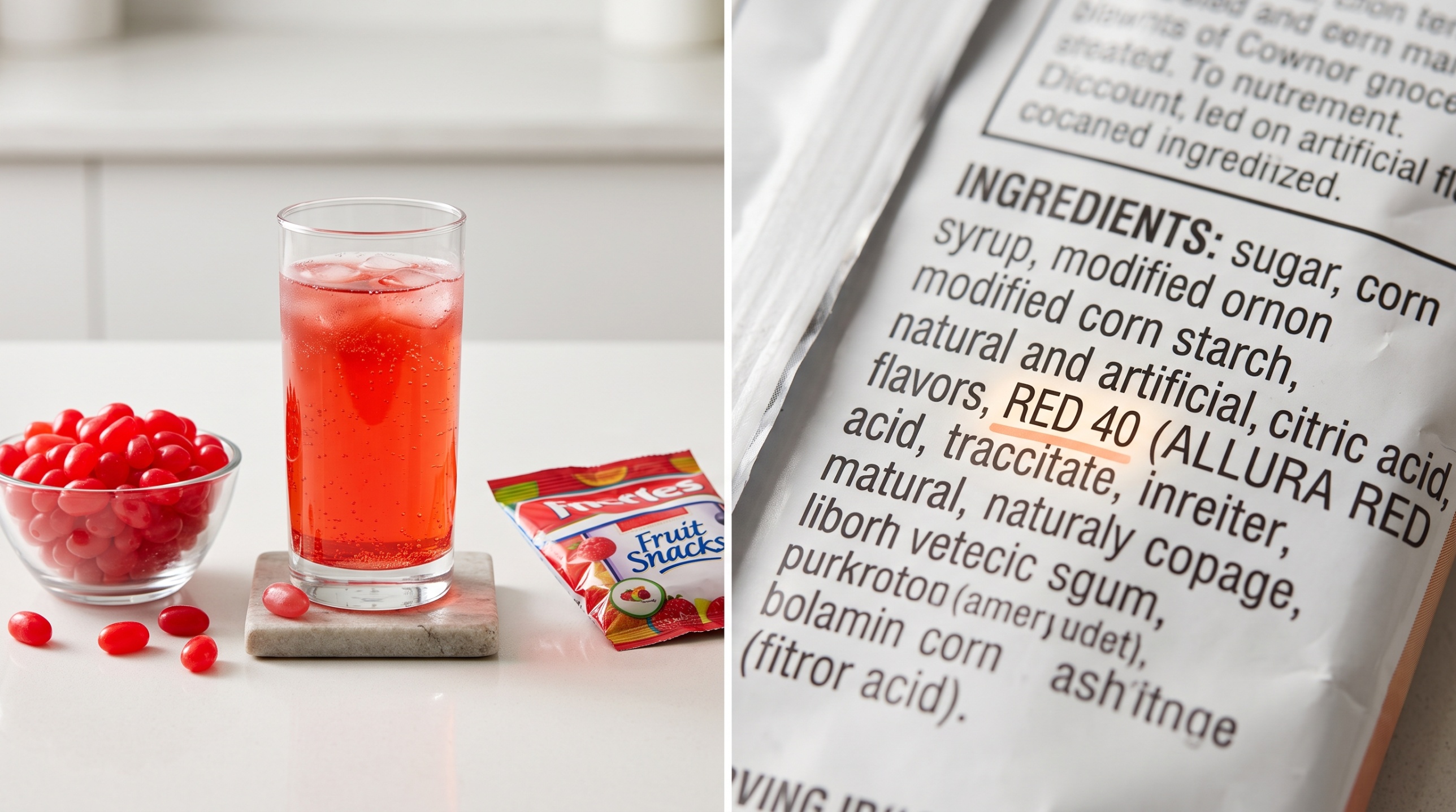
Complete Guide to Preservatives: What They Are, Why They’re Used, and What to Know
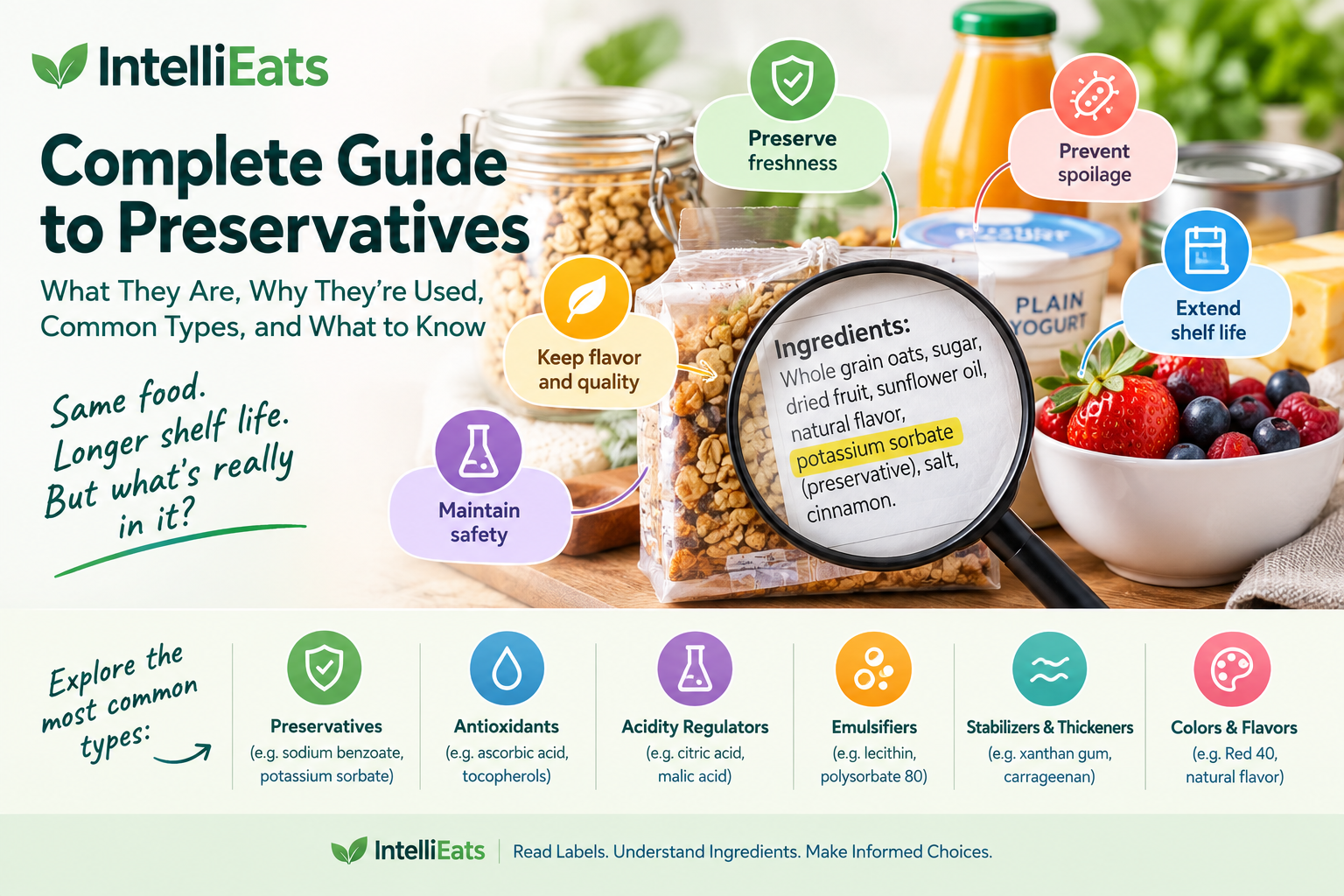
When you look at the ingredient list on a packaged food, you may encounter names such as sodium benzoate, potassium sorbate, calcium propionate, sodium nitrite, BHA, BHT, tocopherols, or citric acid. Some people see these names and immediately wonder:
- Why is this ingredient in my food?
- Is it a preservative?
- Does it make food safer or less healthy?
- Are natural preservatives better than synthetic ones?
- Should children avoid preservatives?
- Why do some foods need preservatives while others don’t?
- How can I identify preservatives quickly on a food label?
The answers aren’t always as simple as “natural is good” or “chemical is bad.”
Preservatives serve important technological and food-safety functions. They can slow the growth of microorganisms, delay spoilage, prevent fats and oils from becoming rancid, maintain freshness, and help preserve the appearance, flavor, and quality of foods. At the same time, different preservatives have different properties, uses, regulatory requirements, and areas of scientific interest.
This guide explains preservatives in plain language so you can better understand what you’re seeing on an ingredient label.
What Are Preservatives?
Preservatives are substances used to help maintain the safety, freshness, quality, or shelf life of food. They can work in several different ways. Some help inhibit the growth of:
Bacteria
Yeasts
Molds
Fungi
Others help protect foods from chemical changes caused by oxygen. Fats and oils can become rancid when exposed to oxygen over time, and certain antioxidant preservatives slow this process.
The U.S. Food and Drug Administration identifies preservatives as ingredients that can prevent spoilage caused by microorganisms or slow changes such as rancidity.
Preservatives are not one single type of ingredient
The word “preservative” describes a function, not one specific chemical family. Different preservatives work differently and may be used in completely different foods:
Sodium benzoate
Commonly used in acidic foods and beverages.
Potassium sorbate
Helps inhibit molds and yeasts.
Calcium propionate
Commonly used in baked goods.
Sodium nitrite
Important in the curing of certain meats.
BHA and BHT
Antioxidants used to help prevent oxidation and rancidity.
Tocopherols
Forms of vitamin E that can also function as antioxidants.
Why Do Foods Need Preservatives?
Food naturally changes over time. After food is produced, several things can happen:
Microbial growth
Bacteria, yeast, and molds can grow under suitable conditions.
Oxidation
Oxygen can cause fats and oils to become rancid and change flavor and quality.
Browning
Some foods undergo chemical or enzymatic reactions that change their color.
Texture changes
Moisture migration and other changes can affect texture.
Flavor changes
Food can develop undesirable flavors as it ages or oxidizes.
The FDA notes that preservatives can help control spoilage and, in some cases, microorganisms that can cause foodborne illness. Preservatives aren’t necessarily added simply for convenience — in some applications, preservation is directly connected to food safety.
Preservatives Have Been Used for Thousands of Years
Modern preservatives may have unfamiliar chemical names, but the basic idea of preservation is very old. People have traditionally used:
Salt
Sugar
Vinegar
Fermentation
Drying
Smoking
Pickling
Salt can make conditions less favorable for many microorganisms. Sugar can help preserve fruits. Vinegar creates an acidic environment that inhibits many microorganisms. Modern food technology builds on these principles using highly controlled ingredients and processing methods.
The Two Major Functional Groups of Preservatives
1. Antimicrobial preservatives
- Sodium benzoate
- Potassium sorbate
- Calcium propionate
- Sodium nitrite
- Sodium sulfite and other sulfiting agents
Help inhibit the growth of bacteria, molds, and yeasts.
2. Antioxidant preservatives
- BHA
- BHT
- Tocopherols
- Ascorbic acid
- Sodium erythorbate
Help slow oxidation, which can cause rancidity, off-flavors, loss of quality, and color changes.
Some ingredients have more than one technological function, so the categories are not always completely separate.
15 Common Preservatives You May See on Food Labels
Sodium Benzoate
- What it is:
- The sodium salt of benzoic acid.
- Primary function:
- Antimicrobial preservative.
Sodium benzoate is particularly useful in acidic foods and beverages, where it can inhibit the growth of microorganisms.
You may encounter it in
What to know
Sodium benzoate is an authorized food ingredient for specified uses in the United States. Its effectiveness is strongly related to the food’s acidity.
When you see sodium benzoate on a label, consider the entire product rather than treating the ingredient name alone as a measure of whether the food is nutritious.
Potassium Sorbate
- What it is:
- The potassium salt of sorbic acid.
- Primary function:
- Antimicrobial preservative.
Potassium sorbate is widely used to inhibit molds and yeasts.
You may encounter it in
What to know
Potassium sorbate is listed by the FDA as a food ingredient with antimicrobial functions. It is especially useful in foods where mold and yeast growth are a concern.
Calcium Propionate
- Primary function:
- Antimicrobial preservative.
Calcium propionate is particularly familiar in baked goods, where it can help inhibit mold growth.
You may encounter it in
Why is it useful in bread?
Bread can contain enough moisture to support mold growth, but consumers expect packaged bread to remain usable for days or weeks. Calcium propionate can help extend shelf life by slowing mold growth.
Sodium Nitrite
- Primary function:
- Preservation, curing, color stabilization, and other technological functions.
Sodium nitrite is best known for its use in cured meats. One of its most important functions is helping inhibit the growth of Clostridium botulinum, the bacterium associated with botulism. It also contributes to the characteristic color and flavor of cured meats and helps delay rancidity.
You may encounter it in
Why is sodium nitrite controversial?
Nitrite chemistry is complicated. Under certain conditions, nitrite can participate in reactions that produce nitrosamines, some of which are carcinogenic. Food-processing practices therefore matter.
USDA guidance notes that ingredients such as ascorbate or erythorbate are used in cured meat processing to help reduce nitrosamine formation.
The same ingredient can have an important food-safety function while also requiring careful control of its use.
Sodium Nitrate
Sodium nitrate is another compound associated with curing. It can be used in certain meat-curing processes and can be converted to nitrite under appropriate conditions. Nitrates and nitrites are closely related but are not the same chemical.
You may encounter it in
A label-reading point
Some products marketed as containing “no added nitrates or nitrites” may use naturally nitrate-containing ingredients such as celery-derived ingredients in their curing process. The front-of-package statement does not necessarily tell the entire preservation story — the ingredient list remains important.
BHA
- Full name:
- Butylated hydroxyanisole
- Primary function:
- Antioxidant.
BHA is used to slow oxidation and help prevent fats and oils from becoming rancid.
You may encounter it in
An important 2026 update: The FDA launched a comprehensive reassessment of BHA in February 2026, considering whether BHA remains safe under its current conditions of use in light of newer scientific information. This does not mean the FDA has declared BHA unsafe — it means the agency is conducting a reassessment.
BHT
- Full name:
- Butylated hydroxytoluene
- Primary function:
- Antioxidant.
BHT helps slow oxidation in fats and oils. It is an example of an antioxidant preservative rather than one primarily intended to stop microbial growth.
You may encounter it in
Tocopherols
Tocopherols are forms of vitamin E. They can function as antioxidants and help protect fats and oils from oxidation.
An ingredient can have a technological function while also being a substance naturally associated with nutrition.
You may encounter it in
Ascorbic Acid
Ascorbic acid is commonly known as vitamin C. It can have several technological functions, including antioxidant activity and helping maintain certain characteristics of food.
You may encounter it in
Is it a preservative?
It can function as a preservative or antioxidant, depending on how it is used. Ingredients should be understood by their function in a particular food, rather than assuming every ingredient has only one purpose.
Sodium Erythorbate
Sodium erythorbate is closely related chemically to ascorbic acid and is widely used in food processing. It functions as an antioxidant and is particularly associated with cured meat products, where it can help accelerate curing reactions and reduce conditions that favor nitrosamine formation.
Sulfites
“Sulfites” refers to a group of sulfur-containing compounds such as sodium sulfite, sodium bisulfite, sodium metabisulfite, and potassium metabisulfite. They may be used to slow microbial growth, prevent browning, maintain appearance, and protect certain foods from oxidation.
You may encounter it in
Important sensitivity information: A small percentage of people, particularly some individuals with asthma, can experience adverse reactions to sulfiting agents. The FDA requires sulfiting agents to be declared on food labels when present at 10 parts per million or greater. If you know you are sensitive to sulfites, read the ingredient list carefully.
Citric Acid
Citric acid occurs naturally in citrus fruits and is also manufactured for use as a food ingredient. It can serve several functions, including acidity regulation, flavor enhancement, antioxidant-related functions, and helping control the environment in which microorganisms grow.
You may encounter it in
Is citric acid always a preservative?
No. Citric acid may help preserve quality in some foods, but it is also widely used as an acidity regulator and flavor ingredient. Seeing it on a label does not automatically mean it was added specifically as a preservative.
Sodium Diacetate
Sodium diacetate is related to acetic acid and can be used as an antimicrobial and acidity-control ingredient. Its effectiveness comes from creating conditions less favorable for certain microorganisms.
You may encounter it in
Calcium Sorbate
Calcium sorbate is a salt of sorbic acid. It functions as a preservative and is related to other sorbates such as potassium sorbate, which are commonly associated with controlling molds and yeasts.
EDTA
- Full name:
- Ethylenediaminetetraacetic acid
EDTA’s food function is different from that of traditional antimicrobial preservatives. Certain EDTA compounds act as chelating agents — they bind metal ions that can promote oxidation and deterioration.
For example, calcium disodium EDTA may be used in certain foods to help maintain quality and stability. This is another example of why the word “preservative” covers several different mechanisms.
Natural vs. Synthetic Preservatives
One of the biggest questions consumers ask is: “Are natural preservatives better?” There is no universal answer. Natural preservation methods have been used for centuries:
Salt
Sugar
Vinegar
Lemon juice
Fermentation
Spices
Drying
Smoking
But natural does not automatically mean safer, and synthetic does not automatically mean dangerous. Safety depends on factors such as:
- The identity of the substance
- The amount used
- How it is used
- How much people consume
- How the substance behaves in the body
- The food matrix
- Available toxicological evidence
- Applicable regulatory requirements
The FDA explains that the presence of a chemical by itself does not determine whether a food is safe; exposure and amount are important considerations.
Why “No Preservatives” Does Not Always Mean “Healthier”
“No artificial preservatives” can be meaningful, but it doesn’t automatically make a food nutritionally superior. A food can contain large amounts of added sugar, high sodium, refined grains, high saturated fat, and few beneficial nutrients while still having no added preservatives. Likewise, a food containing a preservative may provide useful nutrients and fit comfortably into a balanced diet.
Think beyond one ingredient
Ingredient list + Nutrition Facts + serving size + overall dietary pattern
Are Preservatives Bad for Children?
Children often eat packaged foods such as bread, cereals, crackers, yogurt products, snacks, lunch meats, sauces, and baked goods. There is no single category called “preservatives” that can be evaluated as universally good or bad for children — different preservatives have different functions and safety profiles.
Parents who want to reduce additives can take a practical approach:
Compare products
Two similar products may have very different ingredient lists.
Choose more minimally processed foods when practical
Fresh fruits, vegetables, whole grains, beans, and eggs generally have shorter ingredient lists.
Don’t ignore nutrition
A product without preservatives can still be high in added sugar or sodium.
Look for ingredients that matter to your family
If your child has a known sensitivity, identify the specific ingredient rather than avoiding the entire category.
Preservatives and Processed Meat
Cured meats may contain combinations of salt, sodium nitrite, sodium nitrate, sodium erythorbate, sugar, and spices. Nitrite provides important food-safety functions, including inhibition of Clostridium botulinum.
However, processed meat consumption is also a separate nutritional and public-health topic, so it’s useful not to reduce the discussion to “nitrite = bad.” The food category, frequency of consumption, preparation method, and overall dietary pattern all matter.
How Preservatives Appear on Food Labels
Preservatives generally appear in the ingredient list. You might see:
Ingredients: Whole wheat flour, water, yeast, salt, calcium propionate, sunflower oil…
Ingredients: Water, fruit juice concentrate, citric acid, natural flavors, potassium sorbate…
Ingredients: Oil, vinegar, salt, sodium benzoate…
Ingredients are generally listed in descending order by weight under U.S. labeling rules, so position gives some information about relative amount — but the list does not tell you the exact quantity of each ingredient.
How to Identify Preservatives in 30 Seconds
- 1
Step 1: Find the ingredient list
Don’t rely only on the front of the package.
- 2
Step 2: Look for familiar preservative names
Sodium benzoate, potassium sorbate, calcium propionate, sodium nitrite, sodium nitrate, BHA, BHT, sulfites, sodium erythorbate, tocopherols.
- 3
Step 3: Determine the product category
A preservative in bread may serve a very different purpose from one in cured meat.
- 4
Step 4: Look at the Nutrition Facts
Check added sugars, sodium, saturated fat, fiber, protein, and serving size.
- 5
Step 5: Compare another product
Comparing two similar products is often the easiest way to see whether an ingredient matters to you.
How IntelliEats Can Help You Understand Preservatives
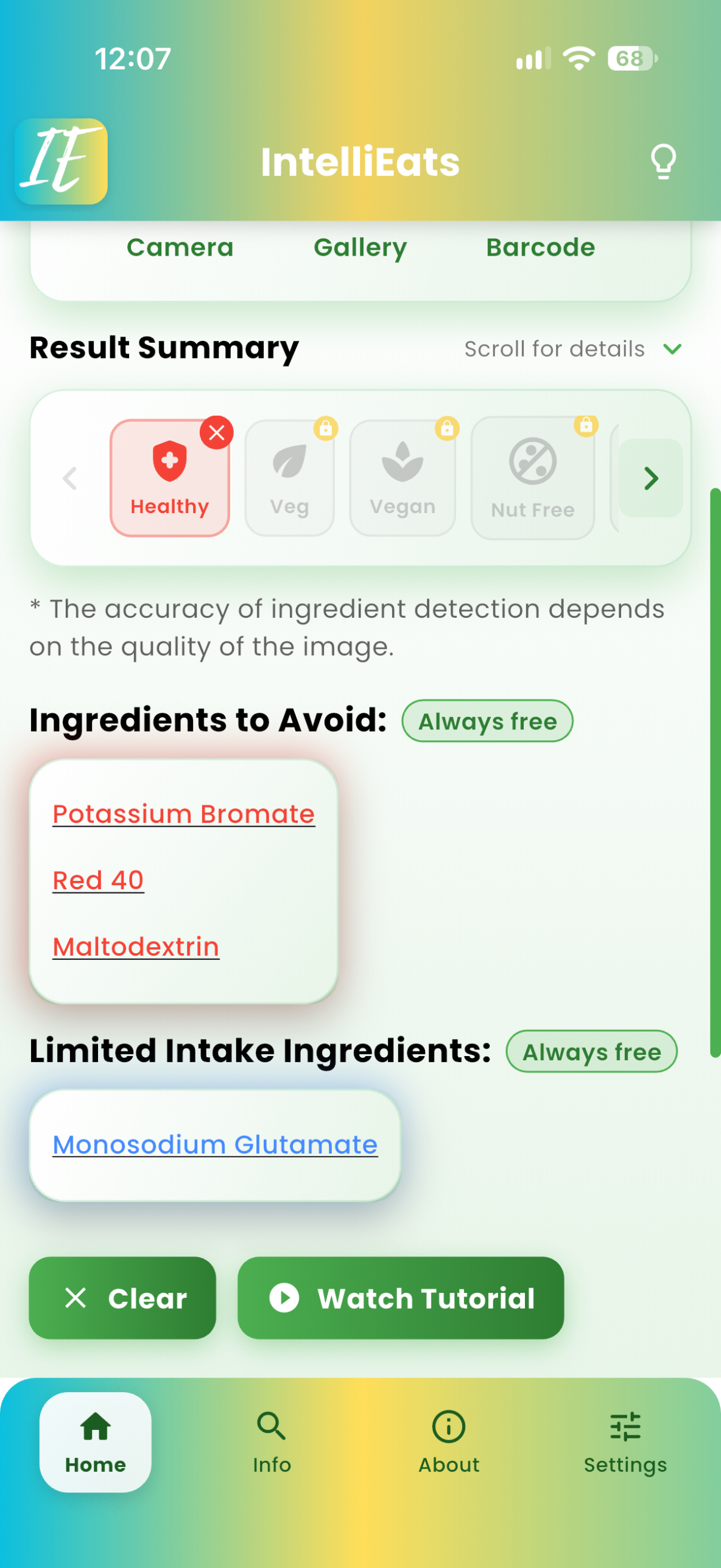
Ingredient lists can be difficult to interpret when you’re shopping quickly — an ingredient such as potassium sorbate may mean very little if you’ve never studied food additives. Instead of manually researching every unfamiliar ingredient, scan the label with your phone’s camera or select an image from your gallery.
- Scan — capture the ingredient list.
- Identify — the app processes the label and identifies ingredient information, including preservatives.
- Learn — explore explanations of unfamiliar ingredients and their common functions.
- Compare — scan another product and compare ingredient lists.
- Decide — choose what fits your personal preferences.
Dietary preferences supported:
The goal isn’t to classify every ingredient as “good” or “bad” — it’s to make the ingredient list easier to understand so you can make your own informed choices.
A Practical Way to Think About Preservatives
Instead of asking “Does this food contain preservatives?” try asking:
What preservative is being used?
Different preservatives have different functions.
Why is it being used?
Is it preventing mold? Slowing oxidation? Controlling bacteria? Maintaining quality?
How much of the food am I eating?
Exposure depends partly on consumption.
What else is in the product?
Look at the entire ingredient list and Nutrition Facts panel.
How frequently do I eat it?
An occasional packaged food and one eaten several times daily represent different patterns.
Quick Reference Table
| Preservative | Main Function | Common Food Uses |
|---|---|---|
| Sodium benzoate | Antimicrobial | Beverages, sauces, acidic foods |
| Potassium sorbate | Antimicrobial | Cheese, baked goods, sauces |
| Calcium propionate | Mold inhibitor | Bread, rolls, baked goods |
| Sodium nitrite | Curing/antimicrobial | Bacon, ham, hot dogs |
| Sodium nitrate | Curing | Certain cured meats |
| BHA | Antioxidant | Cereals, fats, oils, snacks |
| BHT | Antioxidant | Cereals, fats, processed foods |
| Tocopherols | Antioxidant | Oils, cereals, snacks |
| Ascorbic acid | Antioxidant/other functions | Beverages, fruits, bread |
| Sodium erythorbate | Antioxidant/curing aid | Cured meats |
| Sulfites | Antimicrobial/anti-browning | Dried fruits, processed foods |
| Citric acid | Acidity control/other functions | Beverages, sauces, fruit products |
| Sodium diacetate | Antimicrobial/acidity control | Baked and processed foods |
| Calcium sorbate | Preservative | Processed foods |
| Calcium disodium EDTA | Chelating agent | Selected processed foods |
Frequently Asked Questions
Are all preservatives artificial?
No. Traditional preservatives such as salt, sugar, and vinegar can preserve foods, and some modern preservatives are derived from naturally occurring substances. “Natural” and “synthetic” do not, by themselves, determine safety.
Are preservatives necessary?
Not for every food. Some foods are naturally resistant to spoilage or are preserved through refrigeration, freezing, drying, fermentation, canning, or packaging. Others benefit from preservatives to maintain safety and quality during storage and distribution.
Does organic food contain preservatives?
Organic products can contain certain approved preservatives and additives, depending on applicable organic standards. “Organic” and “preservative-free” are not synonymous — read the ingredient list.
Is sodium benzoate harmful?
Sodium benzoate is an authorized food ingredient for specified uses. Its presence does not by itself mean a food is unsafe; safety assessments consider how it is used and consumer exposure.
Is potassium sorbate safe?
Potassium sorbate is used as an antimicrobial preservative and is recognized in U.S. food regulations for specified uses. If you have a specific sensitivity or medical concern, discuss it with a qualified healthcare professional.
Should I avoid BHA?
In February 2026 the FDA launched a comprehensive reassessment of BHA based on current scientific information. That reassessment should not be confused with a determination that BHA is currently unsafe. Consumers who want to limit BHA can identify it on ingredient lists and compare products.
Are preservatives bad for gut health?
Preservatives and the gut microbiome are an active area of research, but it would be inappropriate to treat all preservatives as having the same effect. Don’t automatically apply a study about one preservative to every preservative.
Can preservatives cause allergies?
Some ingredients can cause allergic reactions or sensitivities — sulfiting agents are one example. But preservatives as a broad category should not be treated as a single allergen. Identify the specific ingredient and seek appropriate medical guidance.
The Bottom Line
Preservatives are a broad group of substances used to slow spoilage, control microorganisms, prevent oxidation, maintain freshness, and preserve food quality. Some are antimicrobial, some are antioxidants, and some help control acidity or bind substances that accelerate deterioration.
Common examples include sodium benzoate, potassium sorbate, calcium propionate, sodium nitrite, sodium nitrate, BHA, BHT, tocopherols, sulfites, ascorbic acid, and sodium erythorbate.
The most useful approach is not to fear unfamiliar ingredient names. Instead:
Read → Identify → Understand → Compare → Decide.
The presence of a preservative doesn’t tell you everything about a food’s nutritional quality. Look at the entire ingredient list, the Nutrition Facts panel, serving size, and your overall dietary pattern. For help understanding ingredient labels, IntelliEats lets you scan, identify, and learn about ingredients directly from a food label.
Read labels. Understand ingredients. Make informed choices.
Related IntelliEats Articles
Continue learning about food ingredients:
References and Further Reading
- U.S. Food and Drug Administration — Food Additives and GRAS Ingredients: Information for Consumers
- U.S. Food and Drug Administration — Types of Food Ingredients
- U.S. Food and Drug Administration — Understanding How the FDA Regulates Food Additives and GRAS Ingredients
- U.S. Food and Drug Administration — Chemicals in Foods: The Facts
- U.S. Food and Drug Administration — Food Chemical Safety
- U.S. Food and Drug Administration — Substances Added to Food
- U.S. Food and Drug Administration — Food Allergies and Sulfiting Agents
- U.S. Food and Drug Administration — FDA Launches Assessment of BHA
- U.S. Department of Agriculture, Food Safety and Inspection Service — Clostridium botulinum & Botulism
- U.S. Department of Agriculture, Food Safety and Inspection Service — Additives in Meat and Poultry Products
- U.S. Department of Agriculture, Food Safety and Inspection Service — What Are Nitrites?
- U.S. Department of Agriculture, Food Safety and Inspection Service — What Is Curing?
Last reviewed: September 2026
Medical and dietary disclaimer: This article is for general educational purposes only. It does not diagnose, treat, or prevent disease and does not replace advice from a physician, registered dietitian, allergist, or other qualified healthcare professional.
Research & Regulatory Further Reading
The sources below provide background on food labeling, regulation, and research relevant to this topic. They do not establish that any individual ingredient is harmful at typical food exposure levels.
Medical Disclaimer
The information in this article is provided for educational purposes only and is not intended as medical, nutritional, or dietary advice. Ingredients approved by regulatory authorities are considered safe when used within established limits. Always consult a qualified healthcare professional or registered dietitian for guidance tailored to your personal health needs. See our Editorial Policy to learn how we research and review our content.